
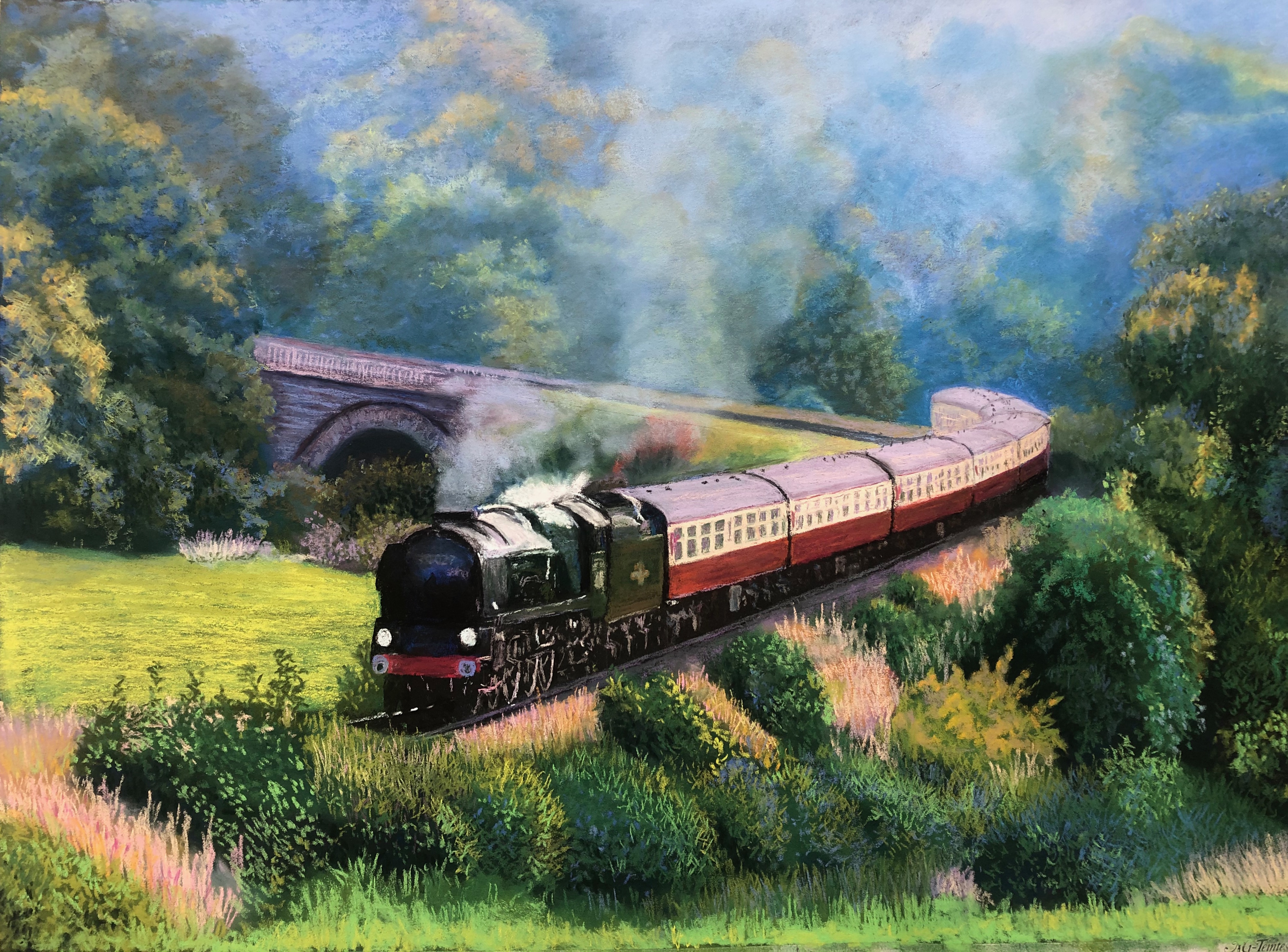
How A Nazi U-Boat Gave Me A Model Train Set for Christmas
... and that changed my life.
Mr Taylor was both a civil servant who worked for a state run bank, and a boring sod. When we visited the Taylors, he sat quietly reading the newspaper and made occasional grunting noises.
However, when I was six years old I didn’t know that Mr Taylor had a very exciting past, which might explain his deep desire for a stable, secure and boring life in the present. He had been a child evacuee from Britain in 1940, and on the voyage to Canada, his ship had been torpedoed by a Nazi U-boat on the high seas. His twin brother was killed, but after surviving several days in a lifeboat, the Royal Navy rescued Mr Taylor, and this intervention resulted in him going to Australia.
Mr Taylor’s boyhood adventure on the high seas was no doubt a seismic event that affected the rest of his life. However, just as Brazilian butterfly flutters can cause storms in Europe, the U-boat and Mr Taylor’s subsequent actions were the butterfly flutters that caused a seismic event that changed my life too.
My mother and Mrs Taylor had become firm friends when they worked together in Melbourne in the early 1950s. When Mrs Taylor married Mr Taylor, they settled into a cream brick veneer home in suburban Melbourne. A few years later my parents married, and by 1968 they had settled on a small farm at Oxley, in North-East Victoria.
At the time, my only interest in Mr Taylor was that he had married the cheerful and kindly Mrs Taylor, who always greeted us with a beaming smile. Moreover, since she had four boys of her own, she was not one of those many women I knew who looked down their noses at six- year-old boys like they were carriers of bubonic plague.
During one visit to the Taylors we were taken next door to meet Mrs Taylor’s parents, and I beheld the most amazing sight I had hitherto confronted in my brief life.
There before me, was a model electric train layout, with a real engine pulling carriages around a track. There were several trains, engines, carriages, a station, and a tunnel. I stared at it goggle eyed. I had never seen anything so wonderful, so beautiful and so endlessly fascinating. Someone showed me how to turn a red dial, enabling me to make the train run faster, slower or stop. When it came time to leave, my father had to drag me away from this heavenly wonder.
From then on, I could not imagine a future without a train, and believe me, my imagination was fertile.
In my mind, the only existential future worth living, was one WITH a train set.
However, we lived on a small, struggling farm. My parents were thrifty. They did not spend money they did not have, and restricted their expenses to those necessary to support the farm, clothe and feed myself and my older brother. But what good would a home, food, clothing and education be if there was no train?
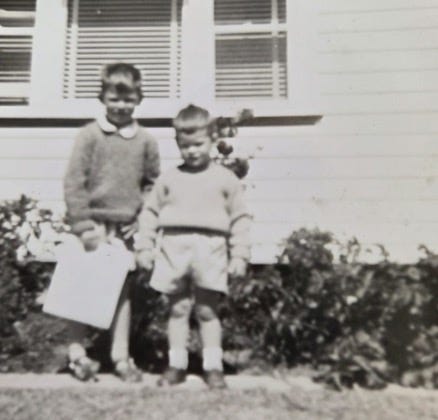
I was young, but I knew that train sets were not only outrageously expensive, they were unnecessary for survival on a small sheep farm, and completely unaffordable to my parents. But God is good, and I’m going to tell you about how He set in motion an extraordinary series of fortunate events that led me to be the proud owner of a train set.
In view of my parent’s impecunious circumstances and thrifty habits, I reasonably concluded my only hope of ever owning a train set was to ask Father Christmas to bring me one. The science and evidence supporting this expectation was overwhelming. Hadn’t I received presents from Father Christmas on Christmas day for as long as I could remember? To me, it was one of the great certainties in life - up there with death and taxes.
Father Christmas could certainly afford a train set, but how would he know about this great existential crisis of my life unless I told him? How would he know that a trainless world was not one in which I could humanly flourish?
In desperation, I wrote him a letter, pooling all my powers of persuasion to tip the Father Christmas decision making scales in favour of a train set. Since I had only recently mastered rudimentary reading and writing skills, letter production was a herculean effort, but desperate times demand monumental measures.
I carefully finished the letter sitting at the kitchen table as my mother bustled about with mundane tasks that kept us alive.
I entrusted the letter to my dependable mother, who faithfully promised to post it for me.
She did no such thing.
She broke that promise.
She thought the letter was priceless, and put it in a special box she kept for precious letters and photos.
But my parents talked about the letter.Perhaps they were proud of my initiative and spoke about it with my grandmother, who lived a short walk from the Taylor’s home.Perhaps they, or my grandmother, talked to Mrs Taylor, who, being the thoughtful, kindly person she was, must have told Mr Taylor.Because Mr Taylor, despite the boring reputation he had so unwittingly cultivated in my eyes, saw an unexpected sight displayed one Saturday morning in the local toy shop window, a few weeks prior to Christmas.
The smallest and lowest cost electric train set in the Tri-ang Hornby range was marked down to half price.
Twelve dollars.
Mr Taylor, exercising amazing powers of imagination and enterprise for a bank teller, told Mrs Taylor, who took the extraordinary step of calling my mother by telephone - a trunk call. Trunk calls were expensive, so it must have been a short call, but she asked my parents if they would like her to buy the train set, so they could pick it up and pay her later.
Twelve dollars seems a giveaway price today, but in 1968 twelve dollars was the equivalent of several hundred dollars, and unaffordable to my parents, except in the most extraordinary circumstances. And there was worse, because 1968 had been an extraordinary year according to the historical record, but for all the wrong reasons.
There were violent riots in France and Paris burned. The Tet offensive raged in the Vietnam War and thousands died. Presidential hopeful Robert F. Kennedy and the Rev Martin Luther King, were both assassinated.
While these geopolitical tragedies had little impact on me or my parents, the severe drought in Australia, which relied on agriculture for its economic backbone, was potentially catastrophic for many farmers. All our wheat, beef and dairy farm neighbours, were experiencing significant income loss, and future prospects were poor. Because everyone was belt tightening, the whole rural economy suffered.
Our farm was small and barely able to support our family in the best years, so how would we survive the worst drought in decades? In such dire circumstances, how could my parents possibly afford to give their six-year-old son a Christmas present of such extravagance? However, by definition miracles are extraordinary events, and unknown to me and my parents, miraculous events were unfolding.
Apart from being small, our farm was less productive than our neighbours because it was wet and swampy. Parts of it were literally wetland, where freshwater crayfish holes and waterweeds abounded in the poorly drained, clay soil. Since it was unsuitable for wheat, we grew oats. Oats don’t pay as well as wheat, but it was a grain we could grow.
The drought caused our soil to be drier than usual. When my father began harvesting oats in November, he could barely travel two hundred meters before his grain bin was full. It was such a bountiful harvest he couldn’t bring it in alone; he had to employ neighbouring farmers to help. Moreover, because the drought caused others to have lower yields, the grain price rose. In a year where everyone else was suffering, we had a dramatic income boost. Suddenly, paying twelve dollars for a train set seemed affordable.
When I awoke on Christmas day, I was delighted, but unsurprised, to find my stocking full, and on the floor a rectangular box I knew to be an electric train set. After all, I had written a very persuasive letter to Father Christmas. What else would it be?
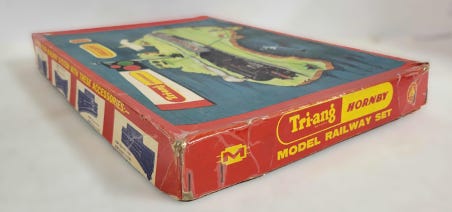
My parents could not know how that little train set put in motion a huge train of thought, learning and activity, that still runs through my life. The curiosity it sparked developed a lifelong love for railways and the engineering that made them possible. A few years later I tried to build an actual model steam train, with a firebox, boiler and pistons. I failed because I lacked the knowledge, skill and tools, but that led me to investigate how cars, ships, trucks, planes and other things work.
My train set taught me to use scarcity to drive innovation. I wanted to extend my track layout with points and carriages, but funds were limited. Instead, I extended it in my imagination. I designed layouts I knew I could never build. I imagined landscapes I knew I would never see. I found ways to improvise, substitute and innovate. I learned to manage funds by saving precious coins to buy that one extra carriage. When I had the opportunity, I watched real trains travelling, loading, and shunting. I climbed all over the real, retired steam engines placed in a children’s playgrounds. I tried to understand how they worked. What was this lever for? What happened when the engineer turned this brass wheel?
Six years later, when I was twelve years old, a train driver let me drive a Queensland Rail diesel-electric train engine. I don’t think we broke any rules because in those days, troublesome Occupational Health and Safety Regulations did not exist.
At high school I became fascinated with the physics and the mathematics that described motion. I studied Engineering at university because I wanted to design and make new machines, and began my engineering career designing equipment for the Australian Army. Later I became an international innovation consultant designing world-first products for companies in Europe, the US and Asia. In 2014 I returned to the farm when I founded the agri-tech startup Agersens to create eShepherd, the world’s first virtual fence of cattle.
I still love railways, particularly steam trains, and I travel on vintage steam railways whenever I have the chance. My heart is still deeply moved when I see a 4-6-2 engine like The Flying Scotsman, hurtling through a landscape or city, blasting steam, smoke and cinders. It is, a most beautiful sight. But so is the quiet, streamlined and elegant beauty of the French TGV, the Japanese Shinkansen, and the Eurostar.
I have two wonderful daughters but no sons. However, to give my daughters the best start in life, I not only fed, clothed and saw them educated, I also gave them a Hornby train set for Christmas one year, and we had a lot of fun together. When we travelled to the UK in 2005, I made sure my daughters spent an afternoon on the Bluebell Railway, travelling behind a 4-6-2 steam engine.
We cannot know how or why God set in motion a series of fortunate events to give direction to a young child’s life. But, through the intervention of a U-boat under the Atlantic, the Royal Navy, and the boring but enterprising Mr Taylor, I received a train set for Christmas and that changed my life.
I still have it.